Cottonwood Commercial Roof Repair Questions

Cottonwood Commercial Roof Repair fixes leaking and damaged roofs on commercial and industrial buildings in Cottonwood, AZ, and nearby Verde Valley towns.

Finding The Leak

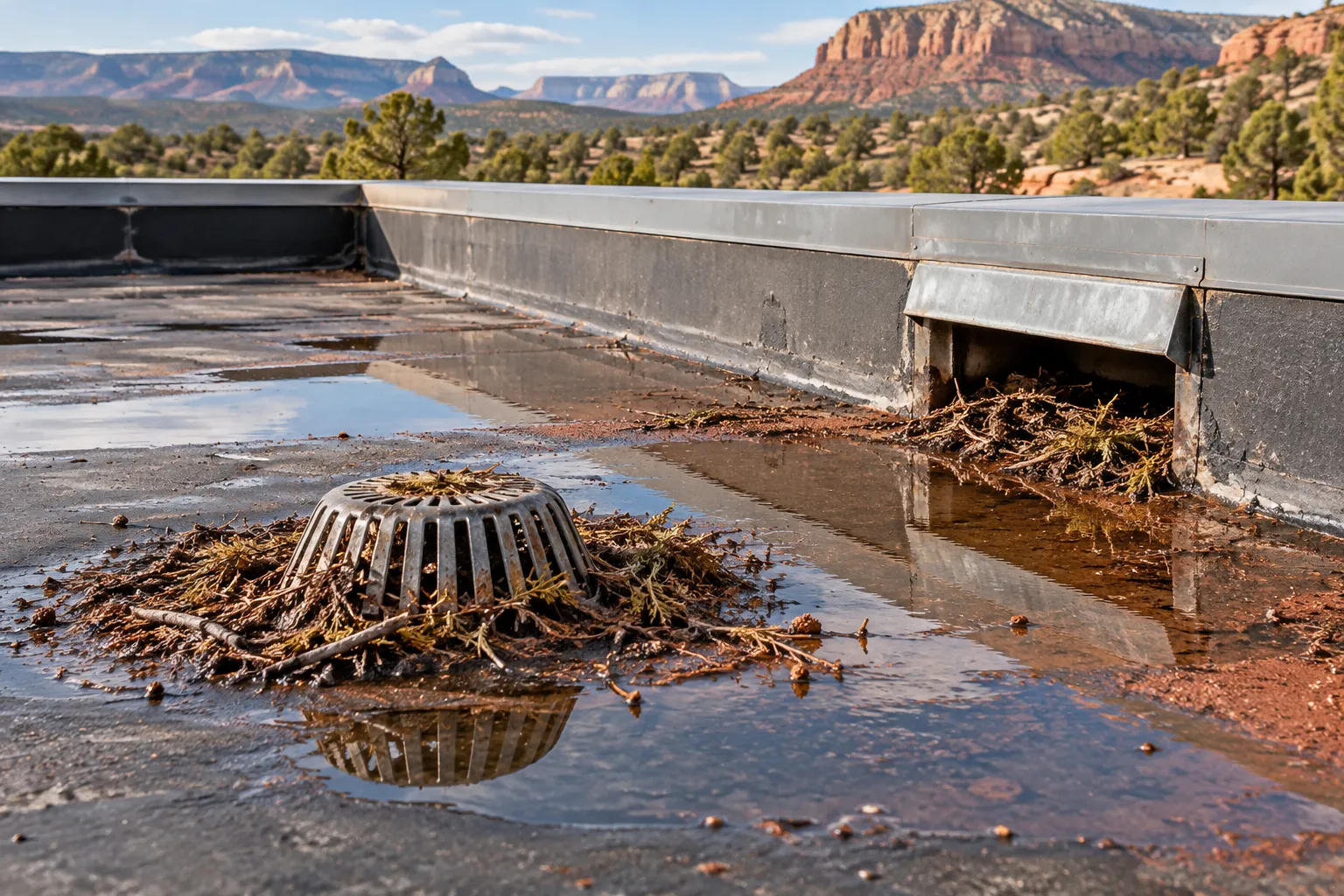
Roof drain and scupper packed with leaves and twigs, with water standing around the strainer

Where do flat commercial roofs in Cottonwood usually leak?

At the joints and edges, far more often than in the open field of the membrane. Check these spots first:

  • Seams and laps that have lifted or split
  • Drains and scuppers packed with dust or leaves
  • Curbs around HVAC units and exhaust vents
  • Parapet caps and the counterflashing under them
  • Pipe boots and pitch pans with dried, cracked sealant

Strong sun and wide temperature swings age the sealant at these points faster than the main sheet. More on flat roof repair in Cottonwood.
Why is the ceiling stain so far from where the roof leaks?

Water travels before it shows up indoors. It can slip under a curb flashing, run along the deck flutes or a purlin, and drip through a ceiling tile several bays away.

Tracing starts at the stain and works upslope across the roof, checking the nearest seams, drains, and penetrations. Moisture meter readings and a controlled water test on one small area at a time narrow down the entry point. More on commercial roof leak repair.

Can a commercial roof leak be controlled before the permanent repair?

Yes. Short-term measures slow the water while materials, weather, or a permit fall into place:

  • Sealant or seam tape over a split lap
  • Tarps weighted down over a torn membrane section
  • Clearing a blocked drain or scupper so water leaves the roof
  • Plastic sheeting and buckets to protect stock under the ceiling stain

Treat these as stopgaps. Plan the permanent seam or flashing repair before the next monsoon storm arrives. More on commercial roof leak repair.

Flat, Metal, And Industrial Repairs

What does flat roof repair include on a Cottonwood commercial building?

It depends on what the inspection finds at the seams, drains, and flashings. Flat roof repair on a retail, office, or medical building often includes:

  • Cleaning and re-welding or re-adhering open seams
  • Replacing cracked flashing at curbs and parapet walls
  • Cutting out blisters and patching with matching membrane
  • Resetting drain clamping rings and scupper liners
  • Building up low spots where a ponding ring shows standing water

Each patch uses the same membrane type already on the roof.

How do you fix leaks on a commercial metal roof?

Most metal roof leaks trace back to a few repeat failures on the panels, and each one has its own fix. Commercial metal roof repair on Verde Valley shops and steel warehouses usually covers:

What you see on the roofUsual repair
Backed-out screws or cracked washersLarger fasteners with new gaskets
Gaps at side laps and end lapsClean, reseal with butyl tape, refasten
Rust bloom around fasteners or cut edgesWire-brush, prime, and coat the area
Cracked or yellowed skylight panelsNew panel sealed into the laps

Daily heat swings in Cottonwood work fasteners loose over time, so full fastener rows near the leak get checked too.

Can you repair an industrial roof without stopping production?

In many cases, yes. Industrial roof repair is planned around the plant, with crews working one section at a time and coordinating with maintenance staff on:

  • Lockout of rooftop units and exhaust fans before work near them
  • Grease, solvent, or process dust near exhaust stacks that attacks membrane
  • Hot work timing near air intakes when torches are needed
  • Walkway pads where heavy foot traffic wears through the roof

Shift changes and delivery windows set the daily work schedule.

Repair Or Replace

When is a commercial roof too damaged to repair?

When wet insulation, deck damage, or age covers too much of the roof. Signs that point toward replacement:

  • Soft spots underfoot, with core cuts showing soaked insulation across large areas
  • Rusted-through steel deck or deck that sags between joists
  • Membrane that cracks when folded, or blisters spread across the field
  • Leaks that keep returning to the same area after several repairs

Isolated damage on a roof with dry insulation and years of life left still favors repair.

How long does a commercial roof repair last?

That depends on the roof around the repair. A new seam weld or flashing on a membrane with good years left can last as long as the roof itself. A patch on brittle, sun-baked membrane fails sooner because the material beside it keeps cracking. Repair life comes down to:

  • Age and flexibility of the surrounding membrane or panels
  • Drainage, since a ponding ring keeps working at patches
  • Foot traffic around rooftop equipment
  • Materials matched to the existing system

What affects the cost of a commercial roof repair?

Scope and access drive it more than anything else. Factors that change the work:

  • Square footage of damaged membrane, panels, or flashing
  • Wet insulation that has to be cut out and replaced
  • Roof height, ladder or lift access, and staging room on site
  • Rooftop equipment that must be shut down or worked around
  • Color or material limits in Sedona and Jerome
  • Permit requirements in each jurisdiction

An inspection measures each of these before pricing comes up.

What maintenance helps prevent commercial roof leaks?

Two inspections a year, one in spring before monsoon season and one in fall before freezing nights, catch most problems while they are small. Between visits, building staff can:

  • Clear drains, scuppers, and gutters of leaves and dust
  • Walk the roof after strong wind and look for lifted flashing or loose panels
  • Keep service techs on walkway pads around HVAC units
  • Report new ceiling stains right away

Log the date and photos from each check.

Leak Getting Worse While You Read?

Call with the stain location and how the roof is reached. Stopgaps slow the water while the permanent repair is planned.

Weather And Storm Damage

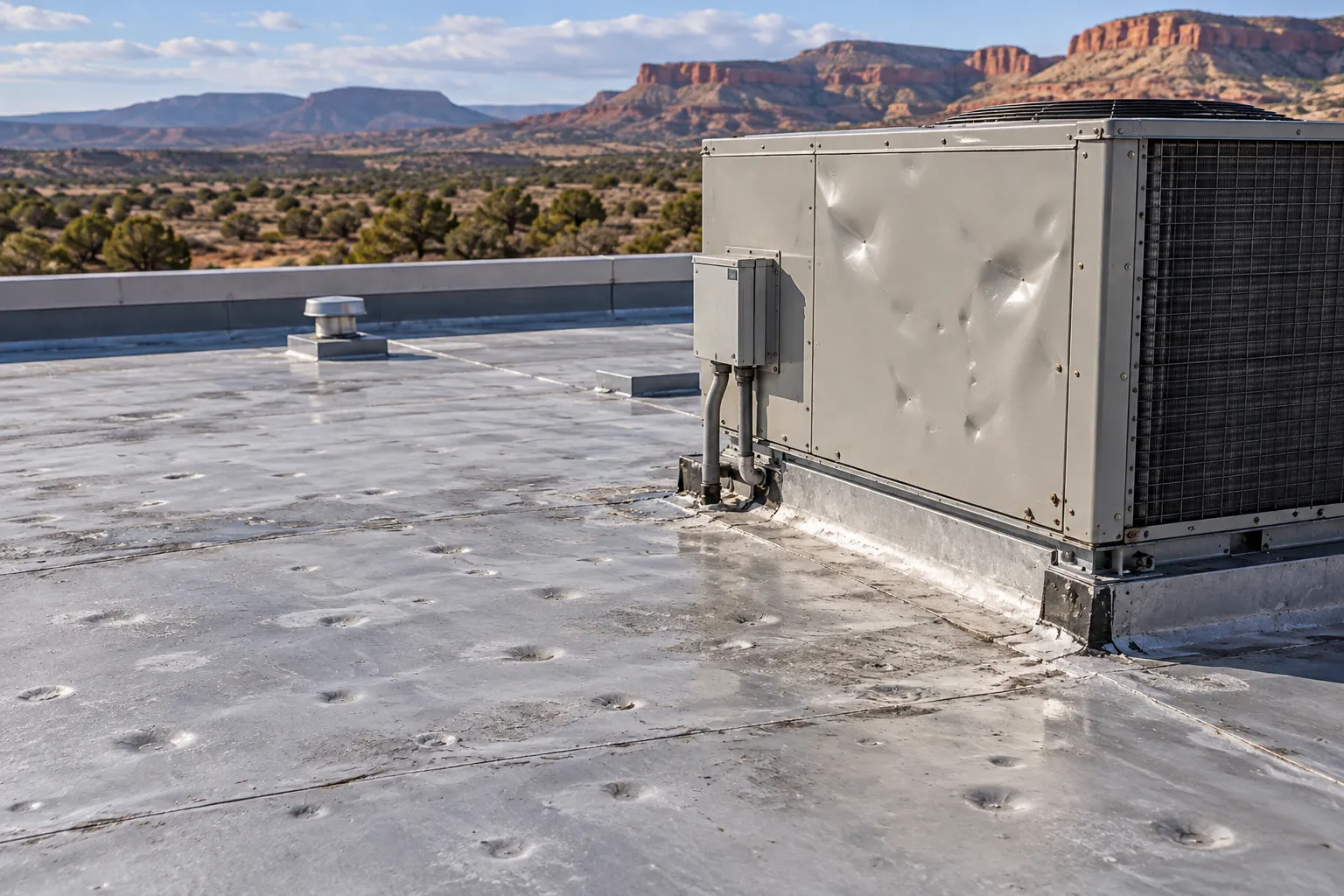
Hail-dented rooftop unit and pocked roof membrane after a storm

How does Cottonwood's climate wear down commercial roofs?

Through sun, sudden storms, and cold nights. Cottonwood sits near 3,300 feet, so roofs face long, hot summers and winter freezes.

  • UV exposure dries out sealant at seams, pipe boots, and pitch pans
  • Monsoon season, dated by the National Weather Service from June 15 to September 30, brings wind gusts and downpours that test drains and scuppers
  • Dust settles in gutters and drain baskets
  • Day-to-night temperature swings flex flashing and loosen metal fasteners

Can freeze-thaw cycles damage commercial roof seams?

Yes. Water sitting in a small seam gap or a ponding ring freezes on cold nights, expands, and pries the opening wider. After enough cycles, a hairline split becomes a leak. On Verde Valley roofs, look for:

  • Open laps where the seam edge has lifted
  • Cracked mastic around drains and curbs
  • Ponding rings that still hold water days after a storm

Fall is a good time to seal small openings before the first hard freeze.

How do I document storm or wind damage on a commercial roof for insurance?

Start with photos and a call to your insurer. Arizona's Department of Insurance and Financial Institutions advises contacting the insurer before repairing or throwing out damaged property, and keeping photos and receipts for emergency repairs. Capture:

  • Wide shots of each roof section, then close-ups of torn membrane, lifted flashing, or bent panels
  • Ceiling stains and wet inventory inside, with dates
  • Blown-off parts on the ground

Verify any contractor's license with the Arizona Registrar of Contractors.

Permits, Local Rules, Taxes, And Utilities

Do I need a permit for commercial roof repair in Cottonwood and nearby towns?

Often, yes, and the issuing office depends on whether the building sits in a city, a town, or unincorporated Yavapai County. Ask the office before any membrane or flashing work starts.

LocationJurisdictionWho issues permits
CottonwoodCityCity of Cottonwood Community Development
ClarkdaleTownTown of Clarkdale Building Division
Camp VerdeTownTown of Camp Verde Development Services
SedonaCityCity of Sedona Community Development
JeromeTownTown of Jerome, with exterior changes reviewed by the Design Review Board
Verde VillageUnincorporatedYavapai County Development Services
Village of Oak CreekUnincorporatedYavapai County Development Services
CornvilleUnincorporatedYavapai County Development Services
RimrockUnincorporatedYavapai County Development Services

Clarkdale requires a permit for roofing work. Camp Verde limits its like-for-like roofing exemption to one- and two-family homes, so commercial roofs there should expect a permit. Confirm jurisdiction by parcel number.

What repair materials and colors are allowed on roofs in Sedona and Jerome?

Both towns control roof appearance, so a repair has to blend with approved colors. Sedona's Land Development Code bans white, bright, and reflective roofs and requires metal to be treated against glare, which rules out bare shiny panels.

All of Jerome commercial roof repair is a National Historic Landmark district, and its Design Review Board uses a paint and roofing review form for exterior changes. Patch membrane, coatings, and metal are sourced in matching muted tones. See also Sedona commercial roof repair.

Can commercial roof repairs qualify for Section 179?

Some can. IRS Publication 946 counts roofs on existing nonresidential buildings as qualified real property when the roof work is placed in service after the building itself. For tax years beginning in 2026, the deduction limit is $2,560,000. Roofs on residential rental property are excluded.

How a seam patch compares with a full membrane re-cover for tax purposes is a question for your CPA, so ask before the work is scheduled.

Does APS offer incentives for commercial roof work?

Sometimes, though programs and funding change from year to year. Arizona Public Service serves many Verde Valley businesses through its Solutions for Business programs, and your utility bill shows which provider serves the building.

Cool-roof incentives, when offered, usually call for a product listed in the Cool Roof Rating Council directory. Confirm eligibility with the utility before choosing a reflective coating or membrane, and remember Sedona's color limits.

Areas And Getting Started

What areas do you serve?

Cottonwood plus eight nearby communities, each with its own roof factor:

How do I get started?

Call us or request a free estimate to set up a free roof inspection. On the roof, the inspection looks at:

  • Seams, laps, and flashing at curbs and parapets
  • Drains, scuppers, and any ponding rings
  • Fasteners, panel laps, and skylights on metal roofs
  • Moisture readings where blisters or soft spots appear
  • Ceiling stains inside, traced back to likely entry points

The findings are explained plainly: what needs repair now and what can wait.

Still Have A Roof Question?

Call and ask, or request a free inspection and get the answer for your own building.

Call Us (928) 436-4827